08 October 2023

Living in the negative space


Tuesday I dropped everything, strapped on my helmet and pantleg elastic, and rode off to the FS training centre to take the Transitioning Home from Life Abroad course. I got lost twice. First I rode up one steep Gatineau hill, only to realize I must re-descend, then l did it again with another.

I hardly noticed the forest alongside but I knew it was there. I'd run its trails during a year of German training eight years ago. l arrived almost but not late to the course.

The pre-course readings included the usual graphs about the emotional stages of transition. It's okay, then bad, then slowly better. You'll just feel wrong. Then less wrong. No one cares how you've changed. Remember that they've changed, too. All this in much more eloquent words, all mostly accurate.

They included an article called That Discomfort You're Feeling is Grief. It was the first sign that someone understood, that all this could be understood. I read all the articles out loud to my husband.

An FS has to do many very different things, often on short notice and without preparation time or training, and must do them more or less competently. They must have this flexibility, self discipline, desire to learn, judgement and ethics, all without subsuming to the internal stresses these flexions create internally.

And one must do this for decades, through children, spouses, sickness, debt, neglected friends and family - all the many things that characterize normal life, while moving from country to country.

It’s very thrilling to satisfy one’s curiosity and fernweh, as the Germans put it - farsickness, as opposed to homesickness. It’s also exhausting. No wonder so many of us end up eccentric or divas, on the boards of one think tank or another, or alone. That’s another way of saying, there’s no way if knowing where this leads.

Another way of describing a life of change and discovery is to notice that new beginnings happen when things end. The things left behind can't be brought along, or not in their fully present way. They leave absences, holes so ragged they can't be stitched up in words. Or I can't.

My phone gives me the option of a typeface that is new to me, called Bahnschrift. This is German and it means, trainwriting. Writing of the way.


My Berlin life in Ottawa


The cheese man in the Byward Market tells me it's tough running a cheese shop in the Market. McDonalds is gone, he goes on, soon Timmies will leave, too. I exult that he sells Tomme de Savoie and Kaltbach, two of my favourite cheeses, but I'm sorry there's no Rote Teufel, which means red devil in German.

When I moved to Germany in 2015, I didn't know cheese. I liked Havarti and cheddar. For my first five years in Germany, I made no progress beyond this. Then, my friend H started invited me to join her on her Saturday morning trips to the market at Winterfeldtplatz. That means, winter field square.

There's a Turkish cheese seller, beloved among market stalls, who plies young customers with lollipops and serves up cheese samples to their elders. He has a smile, gives my change to my son, is always ready with a recommendation. And the prices are good. Sometimes we wait twenty minutes for our turn, canvas bags weighing us down. I don't notice. I'm strong from getting everywhere on foot, my backpack a permanent fixture over my spine.

H teaches me French cheeses, a wealth of information gained from paying attention to her French husband's relatives. Slowly I learn what I like. It takes all of my remaining three years in Berlin. Savoury sheep's cheese with coriander seed, hard oily Manchego threaded with truffles, the softer, younger Swiss mountain cheeses - Kaltbach. I like Brie de Meaux, my husband goes for creamy Delices de Bourgognes, my son likes Red Devil. I learn that I like mostly everything when eaten off the back of the cheese mongers knife. And that I get pickier at home, and as the days elapse since I visited the market.

I have H in my ear today as I pore slowly, lovingly over the cheese in the Byward market cheese shop. In Germany still, she's spending her afternoon watching Germany beat Serbia in the FIBA. We compare first weeks at school for the kids.

I'm alone in the store. Tourists fill the breakfast joints nearby. But the crowd of marketers I remember from Before-Berlin is gone. No one else is loaded down with bags.

During my first month back in Ottawa, I visited the Lansdowne market The crowd is lovely, it's a good market. The sellers are happy, they're selling. The fruit seller with the ponytail practices his German on me.

But the cheese and deli meat selection is spare. So, I'm branching out.

#condoliving #consolidation #ottawa
#ottawa #Berlin #tiergartensued #tiergartensuedcomics #comics #myottawa #bywardmarket #cheese

17 June 2023

Dreaming of Canada


Next month I am moving back to Ottawa, and I don‘t want to go. There‘s no use telling the Germans. But, Lia „Kanada ist das Traumland!“

A dreamland.

They‘re thinking about mountains, Mounties and multiculteralism, and, by God, they‘re right about that.

For me, Canada is the place where I never felt as comfortable as I do in Berlin.

After being forced in Germany to live in a European way, and learning to love it, I realise that in Canada, I lived how I thought I was supposed to live.

Not only did I fail to live the way that I want to live, worse, I didn‘t even know how I wanted to live. I knew I was unhappy. I didn‘t know why.

The sin is people pleasing.

Even though people pleasing makes the world go around. Just ask anyone trying to keep a relationship going, any kind of relationship! Putting your needs and wants into perspective is healthy. We need to meet people halfway, at least partway. We can‘t always get our own way.

But failing even to know what our needs and wants are, like, in the first place? Cringe, says my inner teenager.

Here is what I have learned from living in Germany. I live to move and I need to move. I need stairs, cycle paths, a nearby park for strolling with friends, running or calisthenics.

I need to be able to eat well. I need a good and healthy food supply, and I need time to cook it at home.

I need to know where I live, to understand it and to have a connection to it. I need time for my family and I, for my thoughts and for my friends. And I need time and energy to care for my community. I need a nearby kind of life that I can live without a car.

I don‘t want to move to Canada because I am afraid that I cannot live this way in that country. I feel like my culture has let me down, by favouring concrete and ashphalt over nature, coveting ever-larger homes and cars, fixating on things instead of ideas and culture, putting the bottom line in urban design above people.

But Canada has lots of precious qualities. First among them, people who are warm and open, people who want to be kind. It‘s a very good start, right?

And my family can speak English there, when language has been such a barrier here, despite all my excellent language training.

So I hope that with a little bit of compromise, I can bring this late-in-life knowledge of how I need to live to the next phase of my life in Canada.

This time, it‘s not a house in the suburbs and two cars. Instead, we found a modest apartment downtown, near the farmers‘ market and shops, public transit, schools and library. It‘s not gorgeous, needs work, and I know that for years to come, Canadians will walk into our small home and look around quizzically. Um, so tell me again why you guys decided to live downtown?

I hope it was the right decision. I hope I can proudly say, well, I know it‘s not big and that we can‘t barbecue or play in the yard. But we moved here because we can walk to the brew pub or the theatre or the parade. I pick up food for our meals on my way home from work, instead of spending Saturday morning at the Superstore. We leave the car to languish in the garage. Our kids make their own way by bicycle to school, and they take the bus anywhere they want. They don‘t depend on their parents. We‘re all free.

Maybe once I have settled in at work, I can offer a free comics workshop for kids again, or start up a comics Meet-Up group for adults.

I don‘t know. I hope so. I hope it all works out a bit like I hope.

Have you been able to figure out how you want to live? And could you manage it?


21 February 2022

Comics take over the neighbourhood

This book is a game changer.
Read it in my youth and never
looked back. 
I am in year two of my comics world domination right now, main themes being learning and teaching. 

Last week I hammered out an application for funding for a youth-led course to explore the neighbourhood through comics and the arts in the language of their choice. A local institution had approached me, after someone passed them my neighbourhood web comic, asking if I had any ideas for partnerships. Um, after 20 years in public service, yes, I have ideas! So, they signed on to provide the  event space. 

I have been learning about how young people can steer such opportunities for their own empowerment. My neighbourhood has an alarming number of youth and children in poverty, so the funding will pay my fee so that we can make the course free for them, but all Berlin youth twelve and up are welcome. We hope kids from the co-located Queer Centre will jump in. Drop-in format for those who cannot commit to a weekly course. 

I do not feel really educated enough to offer this course, but you have to start somewhere, and when the institution approached me, I reckoned I better bury the imposter syndrome. Few foreigners are engaged in the community despite us being a huge proportion of the community. So, you know, feel the fear and do it anyway (I loved that book).

I pep talk myself by reminding myself  that I studied creative writing and I have organised lots of events, plus I make comics myself. The other piece, the teaching piece, that's scary, but I did actually teach for two years before joining the foreign service. At the embassy where I served last, I ran an education program. Now, it was my team - not me - that actually met students in an interactive way and I only got pulled in as the suit with a speech. But still, it was good experience. I've got books on teaching art and on sociocultural programming on the coffee table. I have friends who know stuff. I've mothered - as an active verb - for over 12 years. The worst that can happen is that the course sucks. But the next one would be better.

So I hope I get good news this spring once the jury meets.       

22 November 2021

Shorn

Photo Credit © Maja Jancekova

To observers it must be laughingly obvious that last year was the ideal moment, from one perspective, to leave a career and concentrate on obligations at home. I made a great decision. The kids went into partial or full-time schooling in the spring of school year 2019-2020, were again at home due to COVID-19 in the following winter, and then spent several months more in part-time home-schooling this spring. Now, my son is once again thrust into part-time schooling at home. It is such a wonderful thing that I can devote myself to their schooling like this. My kids are lucky.

I chose the wrong time from another perspective, my own, to leave my career. Starting a small art business requires time and dedication. I could already only work part-time on it for a number of reasons, and because of home schooling my available working hours shrank even further. To make a long story short, because people refuse to vaccinate, the full burden of their education falls to me a couple of days a week. My available energy has shrunk even more, because homeschooling is taxing. 

Both of my kids have attention issues, and doing any homework, never mind homeschooling, was always a total struggle. I am yelled at, hit, objects are thrown, I am whined at endlessly, it's exhausting, with little reward, and after years of my own health suffering I walked away in 2020, as I said, from the effort of trying to satisfy the twin demands of career and mothering. I chose a tough course that is humbling, that has involved a punishing drop in prestige and wealth, but that was healthier for everyone. The big bonus is that I love working on comics.

So homeschooling was never going to be easy, but for whatever reason, my children's school has been incapable - unlike most other industries - of getting on top of distance learning. We are in the third Corona school year, and still they cannot do more than send a couple of worksheets home per school day. It is the most difficult of things to motivate children like mine to do busywork like writing out worksheets. The lack of video teaching, group work and interactive activities is destroying their education. Filling in the gaps is impossible at home, when the children are totally resistant. I hear stories of other families, where the kids are engaged via Zoom with their teachers and classes most or all day, but it is better for my mental health not to think about it. It is too frustrating and I refuse to become bitter. 

In September and October I had finally managed to find a rhythm where I reliably painted between 5 and 8 pages of my book a week. Last week I managed three. I am so exhausted from pushing children to do schoolwork and homework that, after the weekend, it is Monday and they are at school today and tomorrow - and I just need to rest.

I started this blog entry about how lucky it is that I can educate my kids, or at least try to do so, because it is not lost on me that there are millions of other families in the far-worse situation where they cannot even dream of filling in the gaps created by this pandemic, never mind working on a financially stupid effort like a graphic novel. 

Counting my blessings always helps me feel marginally better, but it does not finish books.

***

In good news, I got a haircut after two years of butchering my head myself and which I paid for by baking a carrot cake. It turns out that the "amateur hairstylist" I found via Facebook is a talented scissors-wielder AND photog. She took this photo of me, and if I ever get a book deal, I will find a way to pay her for this an an author photo. Her Instagram is _ellenoir_ and if your desire today is to bask in rich, soothing, warm orange and rust coloured glory, click over.


26 August 2021

Freedoms


As I reflect on what is happening in Afghanistan I think about how unusual my day Sunday would seem there. It was an unusually full day. I couldn’t help but notice a few things.


It was a Sunday in an overwhelmingly Christian country but I could be active as an atheist anyway because this country has freedom of religion.


For breakfast I ate cheese that I bought while alone on holiday with my child last week. I am a woman but I can travel without my husband.


I went to a comic book bazaar after lunch and gave out a comic book that I had made in which I comment freely - exercising my freedom of opinion - about my neighbourhood, its past and present, including controversial themes. No one feels that it is not my place to do this work and everyone tried to give me money for my work, even though the book is free. A woman has the right to work. A woman has the right to earn money and to control that money. A worker should be paid for their work.


There, I met up briefly with a female friend on her way to a protest at a government building. She had no fear for her safety and was going alone with her handmade sign. Freedom to assemble, to protest.


Then I biked home - alone, across town, exercising my freedom of movement while being female - and ate the meal my husband had prepared for our family, after he had already spent the day at home with our kids without me.


Then he and I went to a dance performance in which men and women danced an interpretation of contemporary life that had not been reviewed or censored by government prior to performance. The dancers danced intimately, often dancing with different partners. (Not having seen dance in many years, it was just wow!)


The person on call to help our kids in our absence last night, in case something went wrong, is a female full-time journalist. Her husband does not “work”, though of course he does, as they are parents. But anyhow.


All of you who have read this far are exercising your freedom of information and your ability to read.


That’s all I wanted to say.

06 February 2021

You've got a family to run

Since I last wrote - three months or, as we pandemic sufferers experience it, an eternity has passed. In that time, countless women have conceived, grown, or lost babies. I say this because for me the idea of 'three months' doesn't signal a quarter. Three months is a trimester. Perhaps it is like this for other mothers. The other measure is the school year. Once children are in school, the calendar year feels very unreal. New Year's Eve should rightly fall on whatever moment marks the end of the longest school holidays. 

There is the time of the clock, and the time of the body. I spent so much time out on the land and under the sun during my childhood that the need for a wristwatch disappeared for a while. I have not smoked since Christmas Eve 2006, and I still know when six minutes has passed - the time from flame to filter. 
Time oozes so strangely nowadays. And I have much that I would like to report from my little corner! 
           
As for any caregiver of children who faces additional stresses - in our house attention deficits are a relentless pressure - homeschooling and lockdown extract all my resources, my patience, creativity, time, everything. I stay close by phone to my friends with special needs kids, my single mom friends, to anyone in my circle dealing with serious risks. The comfort from the school guidance counsellor - "It's not just kids in difficulty, many kids are having a lot of trouble with motivation. It's really bad." - helps drown out the unintentionally cutting words of the lucky few with independent children and the physical and material resources available to keep life going relatively normally. I just cannot bear it. I am genuinely happy for them - in my case Misery does not want to increase its company - but I cannot listen right now. Casual remarks like, "I expect my son to be independent. I don't look at what homework the school has sent home." Or, "We like her to get the homework done quickly so that the rest of the day is free." As if it were a choice. When all it is, is pure fortune. Now, I know that I am mostly lucky, I have never not known how lucky I am. But the ways in which I am not lucky are a major test at the moment, which I am only just passing.

So, having been worn down by this Lockdown-coupled-with-homeschooling to the point that my every failing and few virtues are in high relief, I am glad, regardless, to have suffered January. I learned a lot about myself, but far more about my kids. I don't blog about my kids in detail much, as I worry I could invade their privacy, but these few weeks have truly increased my respect for them. I am glad that we had this time. I understand them much better, the little jerks, and I really feel for them. And I wish they were going back to school on Monday. 

I pray and pray for strength, as, I imagine, do we all! 


But the good news is that I have won a small grant for expenses for a comics project (unrelated to my book). Since I do not yet have the official paperwork, I won't say more just in case I jinx it. (I make up for my atheism with superstition.) I am just so happy about this! 

Although -- typical for me, don't roll your eyes too much, they might fall out -- I have also been VERY nervous about whether I could do justice to the project that I proposed. Some sleepless nights, over-reliance on my husband's listening skills, etc. 

Being older is nice. I've had so very many occasions over the years to think poorly of myself and to doubt myself, and yet continue to survive at least somewhat intact. It is easier to ignore my own internal nonsense and just keep going. The project involves a great deal of research, so I have just sort of gotten down to it. I have two mental states: the self-doubting, jealous state that I feel when I am not producing creatively, and the mentally healthy, humble and methodical state I feel when I am. I love state number two. I'd like to apply for citizenship to it. Nothing can touch me in state number two. (Why aren't I calling it state number one?) Not jealousy, not mistakes, not awareness of my own totally mediocre skills. I'm just doing. I love it. 

So anyway. Hopefully I can manage the project despite the duties of home-schooling. If not, I will beg the project funder to let me delay for a few weeks. If they resist I will attempt to cajole them with news articles about the disproportionate effect of lockdown measures on women. But I doubt I would need to do that. They seem like really kind folks.

Next subject. My health is a lifelong problem, as some of you know, and I hurt my knees again. I finally managed to run five kilometres, a paltry amount by most runner's standards. This was the first 5K since my insides were injured during the birth of my son in 2012. Carefully cross-training, carefully increasing my distances, I have run without injury since starting again last August. I'd tried the year before, but injured the knees early on from running without orthotics. 

This time, all I appear to have done was to make the for-me stupid mistake of doing some difficult load-bearing exercises the day after the run. My knees immediately started complaining, and I've had swelling on and off for three weeks. The irony is that these exercises were test exercises to determine weaknesses in my body (from the book Runner's Anatomy). 

I was just trying to identify problems. Like a good girl. Why I chose to do these exercises the day after my most difficult run in a decade or so probably falls into the category of stupid things humans do because they evaluate risk badly. So, back to the beginning am I.    

 This post is not wholly art-related. By way of apology, I post here the pre-final line art for Chapter Five from The Engineeress, in various states of progress. I prepared an excerpt of my book based on Chapter four and am sending it out to publications now. If no one picks it up, I might make a zine instead. 

My very first comic publication, my memoir about miscarriage, was recently accepted for publication by Driftwood Press. It comes out later this year. My blessings, like I mentioned, are many. 


But "school" opens again Monday. Please wish me luck!


06 November 2020

Sorry, Tolstoy.

Collage of notes for a comic meet-up plus self-Portrait. Magic Cephalopod character is Lynda Barry’s


I read What It Is by Lynda Barry this week and was very moved. This book was one of several wonderful graphic novels I got my hands on recently, and it is reassuring how varied they are. It becomes easy to see that art is not only arranged in a scale of poor to great but perhaps more consequentially in broad and overlapping spectrums, where quality takes many forms. All unhappy artworks are unhappy in their own way. All happy artworks are happy in their own way, too.

I am being unnecessarily vague. I just mean, the variety of great artwork is comforting now, whereas it used to be overwhelming. I was afraid I would not be able to make a contribution. I felt I needed to be the best. Finally, I see that there is no such thing.

When I had little time and energy for art, my reaction to other people's good works was always envy. Now it might be admiration, intense interest for the purpose of my own learning, the desire to provide resources or other support to the artist. When I look at very good artwork now, I still have a first emotional reaction of insecurity, something like, "I could never do something that good!" I find, though, that my follow on reactions are swift, and more constructive, now that I have more time and energy for my own work, now that I am finally doing my work. My second reaction, it might be something like, "they are very good at what they do! That is not what I want to do, but I like it." Or, "I could learn a lot from this person. I wish I had mentoring opportunities."


The many beauties of Barry’s book include its countless unexpected therapeutic moments nestled within its colorful tapestry. I was able through reading her book to identify a growing wrongness I have been feeling over the last few days. When I left my job in August, I reveled in the increased time I have for my children and my artwork, and how both are benefiting, as I am. But lately I am finding myself constantly refreshing social media stats. Worrying about my shoulder pain. Fretting that I don’t know exactly what to do at every minute of the day. Just having a lot of distracting thoughts, that are clearly pretty useless. It's the sort of anxiety I feel when I don't have certainty.

But I am new to all this, and of course I don’t know very much right now, and have a great deal to learn, and this is a lovely thing – beginner's mind – when you can accept it. Frankly, at the moment I don’t need to ask myself if something I make is good or bad, or even if I am using my time exactly as I should at a given moment. I don’t know if I am doing the right things, and I shouldn’t know. You can see in the picture above a kind of squid creature. Barry calls this the magic cephalopod, and as I understand her, it seems to represent the part of ourselves, or our whole self, that we listen to when we're making our art. It is the antithesis of two questions that close an artist down and distance them from the connection they need to have to themselves. The two questions have to do with judging, is this good? Does this suck? Through my life, they have had a terrible influence on me, as they always do on everyone, I guess. The cephalopod lives in the don't-know space, and that is where I'm trying to stay.

I tried a first exercise, included at the back of this beautiful and wise part-biography, part visual guide, meant to lead artists (back) into their imagination. She asks readers to picture cars that have had significance in one's life, and eventually we are asked to call up an image related to one of these cars – an experience, a memory – and write about it.

So I thought up my ten cars. I remembered a lot of cars from my youth in the 70s and 80s, station wagons, orange Volvo, and my own cars later in life. Next, I focused in on a particular moment with one of them. Wrote about it, using her many writing prompts. I chose to write about a large pickup truck my family had when I was a teenager. It was a Dodge Ram, red, with an extended cab and extended flat.

I remember taking my drivers test in that car, and how the tester told me he'd never had someone do the test in a vehicle that long. I think it was 13 feet, something like 4 m? I couldn't perform the three-point turn in the tiny space provided. I did not find the test very challenging, because I had recently done a weekend motorcycle course with my mom that she and I pushed to finish despite a weekend-long torrential downpour. We were soaked, rain in our underwear and bras, but by Sunday night we were legal to drive the new family dirtbike. 

After completing Barry's exercise, I decided to sketch the truck, because the mental image of the lineup at the testing facility of all the cars, with my gigantic red truck in the middle, was so strong.

But when I draw the truck, I'm not the person behind the wheel. Instead, it's my dad I see. And, the lines of the truck, its color, metal, the shape of the lights, they appear under my pencil more similar to that old Volvo from my childhood. And he is not the age he was when I was a teenager. Instead, he is almost a young man, a young father with his first wrinkles on his brow. He looks afraid, again, not something that I drew on purpose.

I realized earlier this week how unhappy my parents where when I was a child. We did not have an easy time. A story for a different day. It's funny how we can take decades to recognize something so simple.

21 October 2020

In Every Direction


With the goal of building up a modest business for myself making graphic novels and other projects, I work nowadays in many directions to learn what this venture could look like. It’s not possible to jump from obscurity to novel publication, sadly, so I have to figure out what to do beyond The Engineeress. Not that I mind. My failing has always been an inability to focus on one thing.


This process is a bit like going for a bra fitting. I have to take my clothes off, and take a look in the mirror at what I am trying to hold up to scrutiny. Then I measure my dimensions, and make a selection of possible styles. I’m more punk than frilly, but my favourites are the comfortable ones. I am trying on many different things.


Over the last two months, I’ve tried on a few that are very exciting for me - Additional comic-making in order to get some publications. Blogging. Social media presence. Web comics. Attending events. Reading a ton of other people’s works. Contributing to things, pitching into the community. Meeting influential people in the industry. Joining groups with other artists or interested folks.


A big one is figuring out where my work “fits”. And, chief among bra-choosing activities: getting advice from experts.


The next thing I would like to do is find a mentor. Not sure how to go about that yet.


I have just one page left of Eight Weeks, my comic memoir of miscarriage to complete. Above is the probably final design of text - positioning it below the artwork was the only way I could steer people through the comic before they leapt to the words. Seductive little things, words.


Took me a few tries. While the artwork is drawn and one in one step on paper, I added the text in Adobe Photoshop, my go to program after trying the cheaper and free competition. No, I am not sponsored! I wish. I make countless trials and too many errors to ever write on my comics!  


15 October 2020

The word is mightier than my wordless comic


I am not an optimistic person, and tend as a result to see things a bit more clearly than most, and more clearly than is helpful. But I have many blind spots and naturally one of those is my own artwork. 

Example - I created a wordless comic memoir about a miscarriage I experienced. I redrew this comic after a couple of magazines expressed interest but rejected it. It was rejected again. I am re-drawing it again, this time quite differently. It’s much better, I see that. 

I also see finally after two years that it is too difficult to follow. 

How do you draw a doctor offering a woman the choice between a D&C and waiting it out? Especially when many readers won’t even know* what either option even means? 

I used to show the woman mulling over an OR theatre door and an hourglass. It looked terrible.

It’s just clunky to rely on tired symbols to get important and intimate topics across. It’s not a humour comic FFS.

So I decided to add text narrative. This of course brings me down. I wanted to produce a successful wordless comic, art that stands on its own! As soon as there is text on the page, it becomes the lode stone, the main event. Argh. 

But the piece is not an artistic exercise, it is a memoir and I need to stay true to that. True to telling the story the way it seems to need to be told!

So I’m reviewing the text narration styles in my personal collection. So gorgeous! Let me know if you want book titles. 

Clockwise: Alison Bechdel, Barbara Yelin, Birgit Weyhe, Gipi, and Nora Krug in the centre. 


*D&C is the removal of the foetus tissues with a special tool by a doctor, especially useful as sometimes the foetus is not intact and it is a health risk if dead tissue remains inside the woman. 

Waiting it out just means waiting for your body to expel everything. This can take hours or weeks.

14 October 2020

For the love of made-up things

Recently it has dawned on me how often graphic novels are based on historical events or biography. Most graphic novels are graphic memoir, graphic histories or revisionist histories. There is an amazing vein of novels that reimagine the world if, say, the Nazis won the war or what have you. I totally want to check these out but am a bit intimidated. Anyone know where I should start?

I’ve been reading Im selben Boot (In the Same Boat) - a graphic novel about east and west German athletes post-fall of the wall (by Zelba) - that is so well-drawn and so confidently told that I’m fighting imposter syndrome again.


Writing such books confronts the artist with the serious challenge of adapting real life into autobiography. What are the significant moments that should be selected that together will tell this story? 

Often the writer reaches for literary tools like foreshadowing and character development etc by collapsing several events or characters into one, by changing timelines, exaggerating the importance of a moment for frame or suspense, and so on. Everyone must worship at the altar that is Jason Lutes’ trilogy Berlin, where his invented characters live for our enlightenment the vertigo that was Weimar Berlin.

The work improves its appeal to audiences. Reading Stephen Pressfield is how I understood Thermopylae. Yet in many cases, most?, the work distorts reality so that the work is no longer education. Often this sacrifice is worthwhile in the pursuit of awareness raising, for example. Simplifying real life events to make them more palatable at least may result in whetting people’s appetites for facts, right? Based on a true story. 

With all due respect to memoirists and the like - of which I am sort of a member, as some of my better works are autobiographical - I am still a bit freaked out by how little fiction there is in serious comics. Am I looking in the wrong places? Am I trying to find literature on the wrong bookshelf? Is fiction in our post-truth era dead, because truth is so appealing all by itself? Are we in a post-artifice era? Are there only a handful of comic artists allowed to produce works of fiction? Is there no market? 

Or is it just too much to ask of a single author, that they should simultaneously possess the rare elixirs of creative writer, artist and cartoonist all in the same imagination?


I took out Adrian Tomine’s Killing and Dying translated into German (Eindringlinge) from the library the other day. I had not read it before. I made a deal with myself a few years ago, that - knowing I had time for making art or for anything else but not both - that I would do art. 

This is why I have a complete script for Engineeress and eighty percent of my roughs and a bunch of completed line art and two children whom I have managed to keep alive... but I could not tell you what has been published recently. 

So I got this book out of the library along with a few others. Then I ended up buying the book Long-Distance Cartoonist by the same guy, and I was a bit turned off and so I put Killing and Dying aside for a bit. 

Anyway, when I got around to reading it, my expectations were low. I just thought it would elaborate on some of the angst he showed in Long-Distance Cartoonist. Not my thing.

But it is so lovely to climb down from a wrong opinion. (I love changing my mind.)

Killing and Dying was medicine. Comfort, though not because the themes are easy to swallow, or whatever. 

Comforting because his short stories are lovely. They belong in comic form, they exploit the medium beautifully, though I don’t have the means to articulate how, not yet. And simultaneously the stories preserve the short story feel of great fiction. Economy, the short sharp glimpse.

I felt like I was reading fiction, and I love fiction. And I humbly thought it was quite good fiction. 

Which always feels very good. Like a balm. 

I am so relieved to find an author who treats this form, the wonderful graphic novel, in this way. As a form that enjoys the possibilities of both fiction and of art, shortcutting through layers of text description with an image, or in reverse relying on comic exposition over the tired fiction Modernist doctrine of Show Don’t Tell. 

If you know others working in this way, please let me know!

I will go find his other books now.

11 October 2020

ComiXconnection


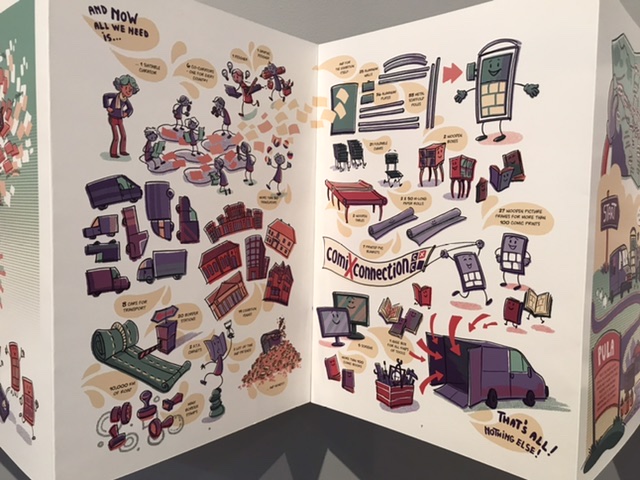
The Museum for European Culture extended the run of ComiXconnection a stunningly curated exhibit of east euro comics. The museum is out of the way in Dahlem on the grounds of Free University, unfortunately.

(But while you’re there you could sneak into the graphic novel collection at the JFK institute. I don’t think they mind visitors, but I have a card, so cannot be sure. Anyway, the books are all in the original languages, and represent likely the biggest collection of North American comics outside Germany.)


The curators of the east European collection have a wonderful eye for space. Throughout the middle of the room, comics and infographics are arranged at eye level on metal displays that look welded together from raw steel. A long and simply gorgeous graphic work about the development of the collection itself ripples along one wall, while blown up images hang on the opposite wall.  


One can also enter a small lounge area through a curtain marked No Entry with yet more displays, this time artifacts behind vitrine. A second room repeats the welded-metal display format, which altogether feature several dozen artists, alongside a second display of comic journalism.


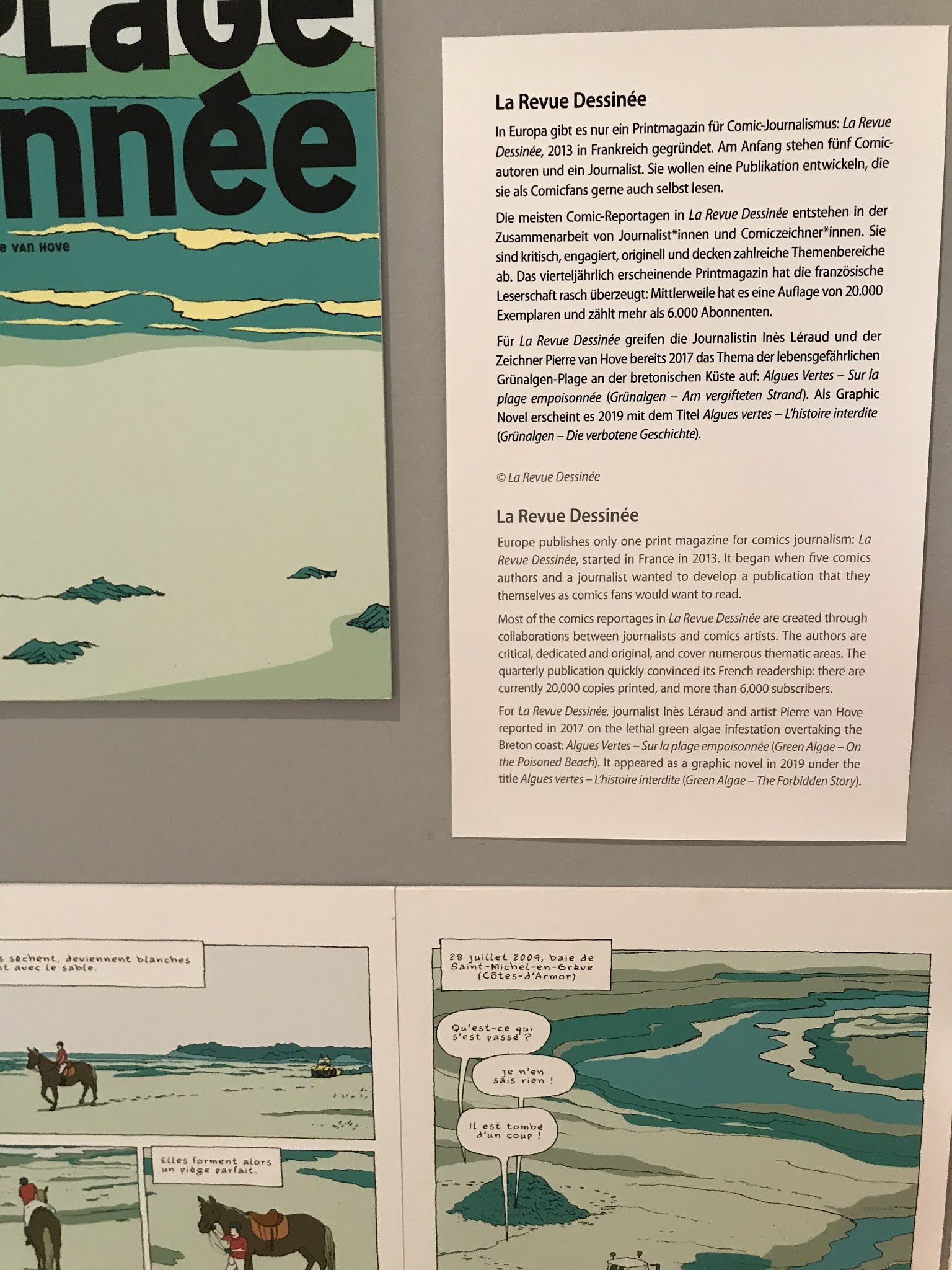
This is how I discovered La Revue Dessinée. This is a quarterly news magazine done entirely as comics or sequential art. This is the most gorgeous thing I have seen since Astrapi.

Part of me wonders what additional value comics bring to news journalism. After all, they add another layer of interpretation. 

When I read the news, I ask myself what the writer might have missed, misinterpreted or even misrepresented. Photographs are accurate but present the same challenge. With comics, unless they are totally copied from photographs (in which case, the question is, what is the point? Is it informative or even creative to reproduce another art form exactly?), they add even more questions. Where did the artist get the content of the photo? Were they there? What made them compose the images in that way? 

I believe fiction can bring us closer to universal or broader truths, but not necessarily to the facts of a live, current news issue. 

On the other hand I have long loved war art, which is not totally dissimilar to comics journalism. War art does not pretend to do current affairs journalism, though. Yet the idea of comics journalism really excites me. It’s so beautiful!

But it is too early to form an opinion.  La Revue can be borrowed from the Mediathek of the Institut Français. I will pick one up sometime soon, and feast my adoring if doubting eyes upon it.

***

Go and see the ComiXconnection exhibit is my gentle advice, and if you do, check out the Slow Fashion exhibit that I did not have time for, and let me know how it was. You could also have a coffee at the café, a tribute to European coffee culture:


10 October 2020

The wisdom of middle age


from “Eight Weeks”

Tonight I began my recovery from two weeks of grant applications. I applied to the Canada Council for the Arts, and then when a trusted friend told me to, I applied for the Berlin Comics grant. After my last submission Wednesday I took a few days to feel disoriented and to catch up on emails. Finally today I went for a run, did a workout. I need my routine back. I have chronic pain that I can keep at bay if I exercise. A two week break means pain plus headaches. Shitty.

I feel like I am starting a new software company in my garage. Writing art grants is an intense process that requires the applicant to develop a rationale for the work, explain their artistic development and directions, put together a project plan and budget for exactly how they will spend the money, etc. It is intense!

I remember when I tried to do this project while I was living  on my parents’ farm in 2005. I gave up after a few months because I was lost in all of the planning and organization required. All these years at my previous job I finally know how to plan and organize a project, balance the administrative burden, track progress, make budgets, weather the emotional ups and downs, plan my day, and so on. 

I wish I had figured all this out earlier. Well, I did, now that I think of it. I was accepted into an art school in 2010 but I decided that I wanted to have another baby instead. I got pregnant, but then I miscarried at eight weeks.

That miscarriage became the subject of my first completed sequential art. I’m re-drawing it  again. 

I was reading advice on grant applications from people who work for the Canada Council for the Arts, and they said that the primary problem is that people underestimate how much effort and time artists put into such tasks. Going to high school for visual arts, studying music, doing my Masters degree in creative writing were all very important for artistic development, but when it came to managing multiyear projects, I was unprepared. 

I've never been a particularly self-aware person, so I just took my confusion as a sign that I should give up

07 October 2020

It’s not for the country, it’s for the world!

 Adrian Tomine and ARTE on Kanada


Tuesday provided an unexpected juxtaposition and very timely window into how artists do things, organise their thinking and their work, their artistic practice. I forced myself to chat to the guy at Grober Unfug, a very important bookseller of graphic novels. I hate talking to people about my art, am super shy, but I’m trying to treat it as a job. 

That’s how I always managed at diplomatic functions - I wasn’t doing it for me, but for Canada. For the country! Hah. It was a thing I did in my head to turn on my artificial inner extrovert.

But I hung around the store for a few minutes, fogging  up my glasses because of my overly-large handmade mask, and finally the other customer left, so. 

He was full of advice and it was awesome and I had better leave that for another post.

To pay for the advice I bought an Adrian Tomine book. „The Loneliness of the Long-Distance Cartoonist” (Drawn & Quarterly 2020). It’s about the artist himself reckoning with his envy, ambition and narcissism, and I couldn’t relate. I certainly have all three of those qualities, of course, but I am not at all driven to do this art thing for those reasons. 


I am thankful that he wrote the book, because it is a foil for the reader. It helped me, as someone reading a book by a master of the craft, see more clearly what kind of artist I am.

That night I happened to attend an ARTE film screening of documentary portraits of Canadian writers. I suppose the intent was to showcase Canadian literature for the Frankfurter Book Fair. But it spoke to me as a rare view into the studios of six mature writers. (See Kanada - Literatur im Ausbruch at www.ARTETV.com/Buchmesse if you understand German).

I am surprised by how easy it is to see already, though I’m no professional artist, what my own practice and motivations and preoccupations are. This makes it easier to identify all of the many things I do not know, or rather, the things that I should know about myself and my work. 

I clung to each moment in the documentaries when the filmmaker honed in on a studio space or shared footage of a writer reflecting on their process or goals. Usually it wasn’t very elaborate. You would think, with the richly creative output, that the kernel of the thing, the intention, would be complex. But no.

This used to bother me. I thought most artists were just not too bright, or that they were ignorant, and they often are. It’s hard, after all, to understand the world when the modern rigours of artistic craft and of  hustling for money take so much time. 

Like how so many professionals are so busy getting the job done that they cannot stay abreast of developments in their field. I know all about that one, regretfully.

I was mistaken, though. The longer I examine this project, The Engineeress, which has possessed me for so many years, the simpler it gets. I am afraid of losing my children. I feel guilty having children. I believe these stories belong in the collective imagination. 

So I laboriously gather reference photos and read websites because that is why I draw pictures.

Blick ins Studio


06 October 2020

It‘s go time

These words from these pages back in 2017 seem uncannily accurate now. 

“Everything I need is in front of me. The story, the pictures. But I don't have much knowledge, time or technique. It's hard not to be discouraged. It's also one thing to do the planning and thumbnails with my bits of time sprinkled here and there. But inking and painting happen at a desk.”

I took the decision a year later to stop working full time and to devote myself this project (and to parenting better, though that is another story).  It took two years to actually get to quitting. 

In the meanwhile I finished several years of updates to the education and multimedia centre I was managing. Those project management skills and resilience and determination are getting a full workout now, as I push ahead on this book. 

Next I was embedded into the German foreign ministry - an unexpected assignment that taught me a lot about surviving loneliness and self-reliance and self-motivation. That is not Germany’s fault or credit. The pandemic broke out, so not only was I the lone Canadian in their system with no handholds or longtime friends, I was actually literally... alone. Connecting daily with my team by visual link.

I hate Zoom now.


So now it is 2020. I left my job last month. 

It’s a new world. Lots more economizing, grant applications, artist meetups and coworking, reaching out to experts to review my work. Lots more art. More pyjamas and less expensive cappuccino. More diving back into what I was working on yesterday instead of spending an hour just trying to remember what page I was on. And, bad art days don’t mean as much, when I have the chance to try again tomorrow!

12 July 2017

Thirty-five plus

If you happened to see me on the way to work or in a restaurant on a Tuesday (art night, yeah!) you would see a red cloth bag on my shoulder. It's from Dussman, a huge bookstore everyone knows, with a good English-language art graphic novel section. I carry the bag everywhere, and so far no one has asked me what is in it. Whenever I have a few minutes, I haul out my book to do some work. After a year, the book is now ​35+ pages of plans long. I have lots of time, but most of it is after a long day of work and childcare, and I don't have the energy. After 9 pm, the only thing I want to do these days is watch kung fu and action movies. I skipped Canada Day to see Wonder Woman at the Odeon on Hauptstrasse at ten p.m. 

Here is a scene from the middle of the book. The main character, Liv, gets pregnant after years of IVF treatments. This part takes place four months into the pregnancy, when she's at work. In the first scene, she finds blood on her underwear.

The reason I am not starting from the beginning is that the earliest pages are super-rough, like almost stick-figures. I thought I would draw sketch out the book roughly then go back in and do more detailed plans. Nope. You can see that progression even in these pages - the last few pages look more like comics than the first ones.

If you can't see the images clearly, open each image in a new tab (right-click on the picture to get this option).

If you have any comments or suggestions, I'm all ears. 


*****


all images copyright Lia Hiltz 2017