06 February 2021

You've got a family to run

Since I last wrote - three months or, as we pandemic sufferers experience it, an eternity has passed. In that time, countless women have conceived, grown, or lost babies. I say this because for me the idea of 'three months' doesn't signal a quarter. Three months is a trimester. Perhaps it is like this for other mothers. The other measure is the school year. Once children are in school, the calendar year feels very unreal. New Year's Eve should rightly fall on whatever moment marks the end of the longest school holidays. 

There is the time of the clock, and the time of the body. I spent so much time out on the land and under the sun during my childhood that the need for a wristwatch disappeared for a while. I have not smoked since Christmas Eve 2006, and I still know when six minutes has passed - the time from flame to filter. 
Time oozes so strangely nowadays. And I have much that I would like to report from my little corner! 
           
As for any caregiver of children who faces additional stresses - in our house attention deficits are a relentless pressure - homeschooling and lockdown extract all my resources, my patience, creativity, time, everything. I stay close by phone to my friends with special needs kids, my single mom friends, to anyone in my circle dealing with serious risks. The comfort from the school guidance counsellor - "It's not just kids in difficulty, many kids are having a lot of trouble with motivation. It's really bad." - helps drown out the unintentionally cutting words of the lucky few with independent children and the physical and material resources available to keep life going relatively normally. I just cannot bear it. I am genuinely happy for them - in my case Misery does not want to increase its company - but I cannot listen right now. Casual remarks like, "I expect my son to be independent. I don't look at what homework the school has sent home." Or, "We like her to get the homework done quickly so that the rest of the day is free." As if it were a choice. When all it is, is pure fortune. Now, I know that I am mostly lucky, I have never not known how lucky I am. But the ways in which I am not lucky are a major test at the moment, which I am only just passing.

So, having been worn down by this Lockdown-coupled-with-homeschooling to the point that my every failing and few virtues are in high relief, I am glad, regardless, to have suffered January. I learned a lot about myself, but far more about my kids. I don't blog about my kids in detail much, as I worry I could invade their privacy, but these few weeks have truly increased my respect for them. I am glad that we had this time. I understand them much better, the little jerks, and I really feel for them. And I wish they were going back to school on Monday. 

I pray and pray for strength, as, I imagine, do we all! 


But the good news is that I have won a small grant for expenses for a comics project (unrelated to my book). Since I do not yet have the official paperwork, I won't say more just in case I jinx it. (I make up for my atheism with superstition.) I am just so happy about this! 

Although -- typical for me, don't roll your eyes too much, they might fall out -- I have also been VERY nervous about whether I could do justice to the project that I proposed. Some sleepless nights, over-reliance on my husband's listening skills, etc. 

Being older is nice. I've had so very many occasions over the years to think poorly of myself and to doubt myself, and yet continue to survive at least somewhat intact. It is easier to ignore my own internal nonsense and just keep going. The project involves a great deal of research, so I have just sort of gotten down to it. I have two mental states: the self-doubting, jealous state that I feel when I am not producing creatively, and the mentally healthy, humble and methodical state I feel when I am. I love state number two. I'd like to apply for citizenship to it. Nothing can touch me in state number two. (Why aren't I calling it state number one?) Not jealousy, not mistakes, not awareness of my own totally mediocre skills. I'm just doing. I love it. 

So anyway. Hopefully I can manage the project despite the duties of home-schooling. If not, I will beg the project funder to let me delay for a few weeks. If they resist I will attempt to cajole them with news articles about the disproportionate effect of lockdown measures on women. But I doubt I would need to do that. They seem like really kind folks.

Next subject. My health is a lifelong problem, as some of you know, and I hurt my knees again. I finally managed to run five kilometres, a paltry amount by most runner's standards. This was the first 5K since my insides were injured during the birth of my son in 2012. Carefully cross-training, carefully increasing my distances, I have run without injury since starting again last August. I'd tried the year before, but injured the knees early on from running without orthotics. 

This time, all I appear to have done was to make the for-me stupid mistake of doing some difficult load-bearing exercises the day after the run. My knees immediately started complaining, and I've had swelling on and off for three weeks. The irony is that these exercises were test exercises to determine weaknesses in my body (from the book Runner's Anatomy). 

I was just trying to identify problems. Like a good girl. Why I chose to do these exercises the day after my most difficult run in a decade or so probably falls into the category of stupid things humans do because they evaluate risk badly. So, back to the beginning am I.    

 This post is not wholly art-related. By way of apology, I post here the pre-final line art for Chapter Five from The Engineeress, in various states of progress. I prepared an excerpt of my book based on Chapter four and am sending it out to publications now. If no one picks it up, I might make a zine instead. 

My very first comic publication, my memoir about miscarriage, was recently accepted for publication by Driftwood Press. It comes out later this year. My blessings, like I mentioned, are many. 


But "school" opens again Monday. Please wish me luck!


06 November 2020

Sorry, Tolstoy.

Collage of notes for a comic meet-up plus self-Portrait. Magic Cephalopod character is Lynda Barry’s


I read What It Is by Lynda Barry this week and was very moved. This book was one of several wonderful graphic novels I got my hands on recently, and it is reassuring how varied they are. It becomes easy to see that art is not only arranged in a scale of poor to great but perhaps more consequentially in broad and overlapping spectrums, where quality takes many forms. All unhappy artworks are unhappy in their own way. All happy artworks are happy in their own way, too.

I am being unnecessarily vague. I just mean, the variety of great artwork is comforting now, whereas it used to be overwhelming. I was afraid I would not be able to make a contribution. I felt I needed to be the best. Finally, I see that there is no such thing.

When I had little time and energy for art, my reaction to other people's good works was always envy. Now it might be admiration, intense interest for the purpose of my own learning, the desire to provide resources or other support to the artist. When I look at very good artwork now, I still have a first emotional reaction of insecurity, something like, "I could never do something that good!" I find, though, that my follow on reactions are swift, and more constructive, now that I have more time and energy for my own work, now that I am finally doing my work. My second reaction, it might be something like, "they are very good at what they do! That is not what I want to do, but I like it." Or, "I could learn a lot from this person. I wish I had mentoring opportunities."


The many beauties of Barry’s book include its countless unexpected therapeutic moments nestled within its colorful tapestry. I was able through reading her book to identify a growing wrongness I have been feeling over the last few days. When I left my job in August, I reveled in the increased time I have for my children and my artwork, and how both are benefiting, as I am. But lately I am finding myself constantly refreshing social media stats. Worrying about my shoulder pain. Fretting that I don’t know exactly what to do at every minute of the day. Just having a lot of distracting thoughts, that are clearly pretty useless. It's the sort of anxiety I feel when I don't have certainty.

But I am new to all this, and of course I don’t know very much right now, and have a great deal to learn, and this is a lovely thing – beginner's mind – when you can accept it. Frankly, at the moment I don’t need to ask myself if something I make is good or bad, or even if I am using my time exactly as I should at a given moment. I don’t know if I am doing the right things, and I shouldn’t know. You can see in the picture above a kind of squid creature. Barry calls this the magic cephalopod, and as I understand her, it seems to represent the part of ourselves, or our whole self, that we listen to when we're making our art. It is the antithesis of two questions that close an artist down and distance them from the connection they need to have to themselves. The two questions have to do with judging, is this good? Does this suck? Through my life, they have had a terrible influence on me, as they always do on everyone, I guess. The cephalopod lives in the don't-know space, and that is where I'm trying to stay.

I tried a first exercise, included at the back of this beautiful and wise part-biography, part visual guide, meant to lead artists (back) into their imagination. She asks readers to picture cars that have had significance in one's life, and eventually we are asked to call up an image related to one of these cars – an experience, a memory – and write about it.

So I thought up my ten cars. I remembered a lot of cars from my youth in the 70s and 80s, station wagons, orange Volvo, and my own cars later in life. Next, I focused in on a particular moment with one of them. Wrote about it, using her many writing prompts. I chose to write about a large pickup truck my family had when I was a teenager. It was a Dodge Ram, red, with an extended cab and extended flat.

I remember taking my drivers test in that car, and how the tester told me he'd never had someone do the test in a vehicle that long. I think it was 13 feet, something like 4 m? I couldn't perform the three-point turn in the tiny space provided. I did not find the test very challenging, because I had recently done a weekend motorcycle course with my mom that she and I pushed to finish despite a weekend-long torrential downpour. We were soaked, rain in our underwear and bras, but by Sunday night we were legal to drive the new family dirtbike. 

After completing Barry's exercise, I decided to sketch the truck, because the mental image of the lineup at the testing facility of all the cars, with my gigantic red truck in the middle, was so strong.

But when I draw the truck, I'm not the person behind the wheel. Instead, it's my dad I see. And, the lines of the truck, its color, metal, the shape of the lights, they appear under my pencil more similar to that old Volvo from my childhood. And he is not the age he was when I was a teenager. Instead, he is almost a young man, a young father with his first wrinkles on his brow. He looks afraid, again, not something that I drew on purpose.

I realized earlier this week how unhappy my parents where when I was a child. We did not have an easy time. A story for a different day. It's funny how we can take decades to recognize something so simple.

21 October 2020

In Every Direction


With the goal of building up a modest business for myself making graphic novels and other projects, I work nowadays in many directions to learn what this venture could look like. It’s not possible to jump from obscurity to novel publication, sadly, so I have to figure out what to do beyond The Engineeress. Not that I mind. My failing has always been an inability to focus on one thing.


This process is a bit like going for a bra fitting. I have to take my clothes off, and take a look in the mirror at what I am trying to hold up to scrutiny. Then I measure my dimensions, and make a selection of possible styles. I’m more punk than frilly, but my favourites are the comfortable ones. I am trying on many different things.


Over the last two months, I’ve tried on a few that are very exciting for me - Additional comic-making in order to get some publications. Blogging. Social media presence. Web comics. Attending events. Reading a ton of other people’s works. Contributing to things, pitching into the community. Meeting influential people in the industry. Joining groups with other artists or interested folks.


A big one is figuring out where my work “fits”. And, chief among bra-choosing activities: getting advice from experts.


The next thing I would like to do is find a mentor. Not sure how to go about that yet.


I have just one page left of Eight Weeks, my comic memoir of miscarriage to complete. Above is the probably final design of text - positioning it below the artwork was the only way I could steer people through the comic before they leapt to the words. Seductive little things, words.


Took me a few tries. While the artwork is drawn and one in one step on paper, I added the text in Adobe Photoshop, my go to program after trying the cheaper and free competition. No, I am not sponsored! I wish. I make countless trials and too many errors to ever write on my comics!  


15 October 2020

The word is mightier than my wordless comic


I am not an optimistic person, and tend as a result to see things a bit more clearly than most, and more clearly than is helpful. But I have many blind spots and naturally one of those is my own artwork. 

Example - I created a wordless comic memoir about a miscarriage I experienced. I redrew this comic after a couple of magazines expressed interest but rejected it. It was rejected again. I am re-drawing it again, this time quite differently. It’s much better, I see that. 

I also see finally after two years that it is too difficult to follow. 

How do you draw a doctor offering a woman the choice between a D&C and waiting it out? Especially when many readers won’t even know* what either option even means? 

I used to show the woman mulling over an OR theatre door and an hourglass. It looked terrible.

It’s just clunky to rely on tired symbols to get important and intimate topics across. It’s not a humour comic FFS.

So I decided to add text narrative. This of course brings me down. I wanted to produce a successful wordless comic, art that stands on its own! As soon as there is text on the page, it becomes the lode stone, the main event. Argh. 

But the piece is not an artistic exercise, it is a memoir and I need to stay true to that. True to telling the story the way it seems to need to be told!

So I’m reviewing the text narration styles in my personal collection. So gorgeous! Let me know if you want book titles. 

Clockwise: Alison Bechdel, Barbara Yelin, Birgit Weyhe, Gipi, and Nora Krug in the centre. 


*D&C is the removal of the foetus tissues with a special tool by a doctor, especially useful as sometimes the foetus is not intact and it is a health risk if dead tissue remains inside the woman. 

Waiting it out just means waiting for your body to expel everything. This can take hours or weeks.

14 October 2020

For the love of made-up things

Recently it has dawned on me how often graphic novels are based on historical events or biography. Most graphic novels are graphic memoir, graphic histories or revisionist histories. There is an amazing vein of novels that reimagine the world if, say, the Nazis won the war or what have you. I totally want to check these out but am a bit intimidated. Anyone know where I should start?

I’ve been reading Im selben Boot (In the Same Boat) - a graphic novel about east and west German athletes post-fall of the wall (by Zelba) - that is so well-drawn and so confidently told that I’m fighting imposter syndrome again.


Writing such books confronts the artist with the serious challenge of adapting real life into autobiography. What are the significant moments that should be selected that together will tell this story? 

Often the writer reaches for literary tools like foreshadowing and character development etc by collapsing several events or characters into one, by changing timelines, exaggerating the importance of a moment for frame or suspense, and so on. Everyone must worship at the altar that is Jason Lutes’ trilogy Berlin, where his invented characters live for our enlightenment the vertigo that was Weimar Berlin.

The work improves its appeal to audiences. Reading Stephen Pressfield is how I understood Thermopylae. Yet in many cases, most?, the work distorts reality so that the work is no longer education. Often this sacrifice is worthwhile in the pursuit of awareness raising, for example. Simplifying real life events to make them more palatable at least may result in whetting people’s appetites for facts, right? Based on a true story. 

With all due respect to memoirists and the like - of which I am sort of a member, as some of my better works are autobiographical - I am still a bit freaked out by how little fiction there is in serious comics. Am I looking in the wrong places? Am I trying to find literature on the wrong bookshelf? Is fiction in our post-truth era dead, because truth is so appealing all by itself? Are we in a post-artifice era? Are there only a handful of comic artists allowed to produce works of fiction? Is there no market? 

Or is it just too much to ask of a single author, that they should simultaneously possess the rare elixirs of creative writer, artist and cartoonist all in the same imagination?


I took out Adrian Tomine’s Killing and Dying translated into German (Eindringlinge) from the library the other day. I had not read it before. I made a deal with myself a few years ago, that - knowing I had time for making art or for anything else but not both - that I would do art. 

This is why I have a complete script for Engineeress and eighty percent of my roughs and a bunch of completed line art and two children whom I have managed to keep alive... but I could not tell you what has been published recently. 

So I got this book out of the library along with a few others. Then I ended up buying the book Long-Distance Cartoonist by the same guy, and I was a bit turned off and so I put Killing and Dying aside for a bit. 

Anyway, when I got around to reading it, my expectations were low. I just thought it would elaborate on some of the angst he showed in Long-Distance Cartoonist. Not my thing.

But it is so lovely to climb down from a wrong opinion. (I love changing my mind.)

Killing and Dying was medicine. Comfort, though not because the themes are easy to swallow, or whatever. 

Comforting because his short stories are lovely. They belong in comic form, they exploit the medium beautifully, though I don’t have the means to articulate how, not yet. And simultaneously the stories preserve the short story feel of great fiction. Economy, the short sharp glimpse.

I felt like I was reading fiction, and I love fiction. And I humbly thought it was quite good fiction. 

Which always feels very good. Like a balm. 

I am so relieved to find an author who treats this form, the wonderful graphic novel, in this way. As a form that enjoys the possibilities of both fiction and of art, shortcutting through layers of text description with an image, or in reverse relying on comic exposition over the tired fiction Modernist doctrine of Show Don’t Tell. 

If you know others working in this way, please let me know!

I will go find his other books now.

11 October 2020

ComiXconnection


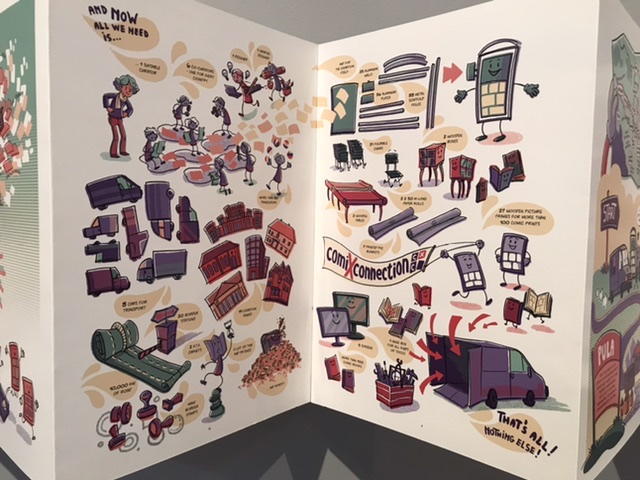
The Museum for European Culture extended the run of ComiXconnection a stunningly curated exhibit of east euro comics. The museum is out of the way in Dahlem on the grounds of Free University, unfortunately.

(But while you’re there you could sneak into the graphic novel collection at the JFK institute. I don’t think they mind visitors, but I have a card, so cannot be sure. Anyway, the books are all in the original languages, and represent likely the biggest collection of North American comics outside Germany.)


The curators of the east European collection have a wonderful eye for space. Throughout the middle of the room, comics and infographics are arranged at eye level on metal displays that look welded together from raw steel. A long and simply gorgeous graphic work about the development of the collection itself ripples along one wall, while blown up images hang on the opposite wall.  


One can also enter a small lounge area through a curtain marked No Entry with yet more displays, this time artifacts behind vitrine. A second room repeats the welded-metal display format, which altogether feature several dozen artists, alongside a second display of comic journalism.


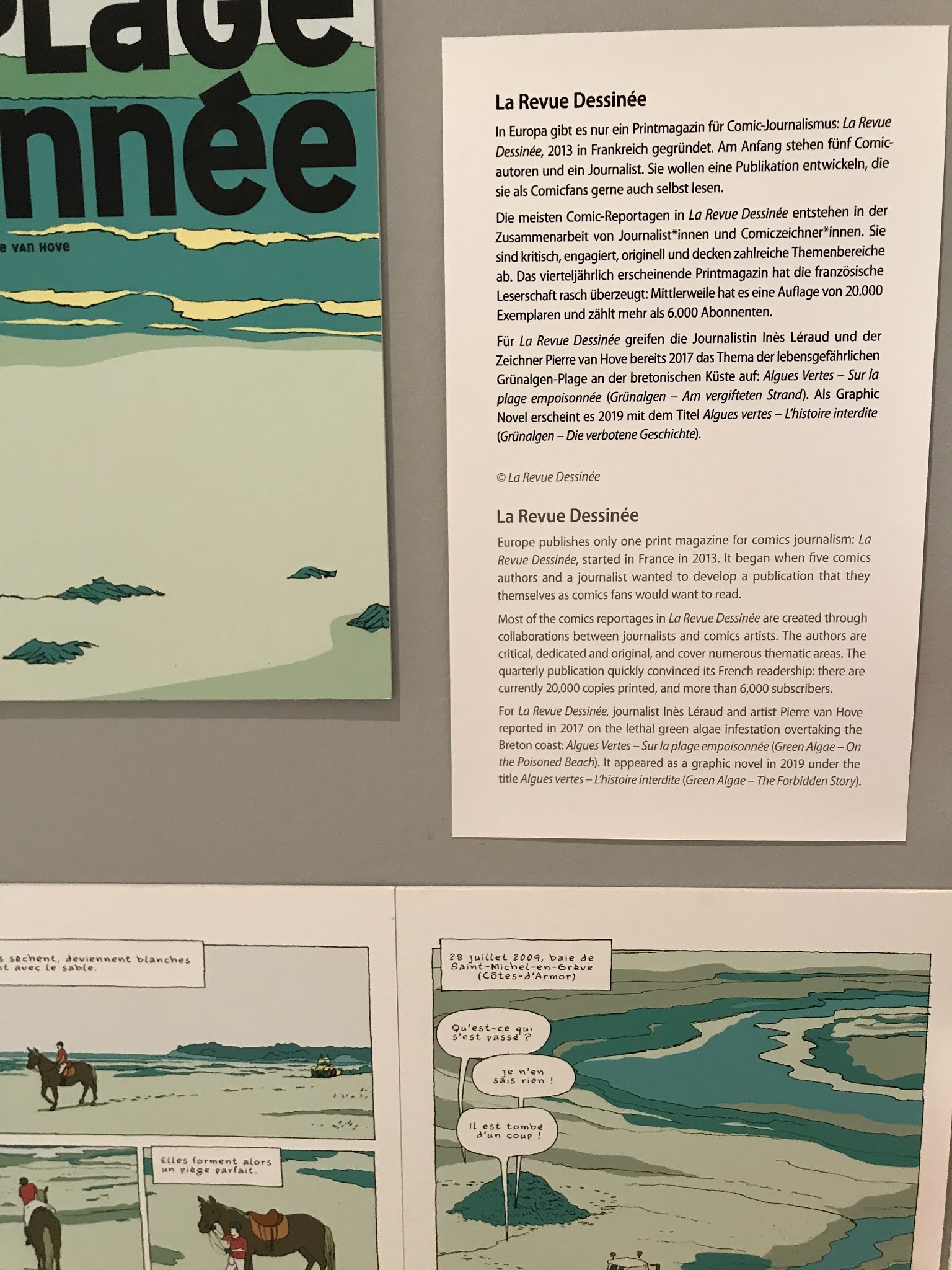
This is how I discovered La Revue Dessinée. This is a quarterly news magazine done entirely as comics or sequential art. This is the most gorgeous thing I have seen since Astrapi.

Part of me wonders what additional value comics bring to news journalism. After all, they add another layer of interpretation. 

When I read the news, I ask myself what the writer might have missed, misinterpreted or even misrepresented. Photographs are accurate but present the same challenge. With comics, unless they are totally copied from photographs (in which case, the question is, what is the point? Is it informative or even creative to reproduce another art form exactly?), they add even more questions. Where did the artist get the content of the photo? Were they there? What made them compose the images in that way? 

I believe fiction can bring us closer to universal or broader truths, but not necessarily to the facts of a live, current news issue. 

On the other hand I have long loved war art, which is not totally dissimilar to comics journalism. War art does not pretend to do current affairs journalism, though. Yet the idea of comics journalism really excites me. It’s so beautiful!

But it is too early to form an opinion.  La Revue can be borrowed from the Mediathek of the Institut Français. I will pick one up sometime soon, and feast my adoring if doubting eyes upon it.

***

Go and see the ComiXconnection exhibit is my gentle advice, and if you do, check out the Slow Fashion exhibit that I did not have time for, and let me know how it was. You could also have a coffee at the café, a tribute to European coffee culture: