07 October 2020

It’s not for the country, it’s for the world!

 Adrian Tomine and ARTE on Kanada


Tuesday provided an unexpected juxtaposition and very timely window into how artists do things, organise their thinking and their work, their artistic practice. I forced myself to chat to the guy at Grober Unfug, a very important bookseller of graphic novels. I hate talking to people about my art, am super shy, but I’m trying to treat it as a job. 

That’s how I always managed at diplomatic functions - I wasn’t doing it for me, but for Canada. For the country! Hah. It was a thing I did in my head to turn on my artificial inner extrovert.

But I hung around the store for a few minutes, fogging  up my glasses because of my overly-large handmade mask, and finally the other customer left, so. 

He was full of advice and it was awesome and I had better leave that for another post.

To pay for the advice I bought an Adrian Tomine book. „The Loneliness of the Long-Distance Cartoonist” (Drawn & Quarterly 2020). It’s about the artist himself reckoning with his envy, ambition and narcissism, and I couldn’t relate. I certainly have all three of those qualities, of course, but I am not at all driven to do this art thing for those reasons. 


I am thankful that he wrote the book, because it is a foil for the reader. It helped me, as someone reading a book by a master of the craft, see more clearly what kind of artist I am.

That night I happened to attend an ARTE film screening of documentary portraits of Canadian writers. I suppose the intent was to showcase Canadian literature for the Frankfurter Book Fair. But it spoke to me as a rare view into the studios of six mature writers. (See Kanada - Literatur im Ausbruch at www.ARTETV.com/Buchmesse if you understand German).

I am surprised by how easy it is to see already, though I’m no professional artist, what my own practice and motivations and preoccupations are. This makes it easier to identify all of the many things I do not know, or rather, the things that I should know about myself and my work. 

I clung to each moment in the documentaries when the filmmaker honed in on a studio space or shared footage of a writer reflecting on their process or goals. Usually it wasn’t very elaborate. You would think, with the richly creative output, that the kernel of the thing, the intention, would be complex. But no.

This used to bother me. I thought most artists were just not too bright, or that they were ignorant, and they often are. It’s hard, after all, to understand the world when the modern rigours of artistic craft and of  hustling for money take so much time. 

Like how so many professionals are so busy getting the job done that they cannot stay abreast of developments in their field. I know all about that one, regretfully.

I was mistaken, though. The longer I examine this project, The Engineeress, which has possessed me for so many years, the simpler it gets. I am afraid of losing my children. I feel guilty having children. I believe these stories belong in the collective imagination. 

So I laboriously gather reference photos and read websites because that is why I draw pictures.

Blick ins Studio


06 October 2020

It‘s go time

These words from these pages back in 2017 seem uncannily accurate now. 

“Everything I need is in front of me. The story, the pictures. But I don't have much knowledge, time or technique. It's hard not to be discouraged. It's also one thing to do the planning and thumbnails with my bits of time sprinkled here and there. But inking and painting happen at a desk.”

I took the decision a year later to stop working full time and to devote myself this project (and to parenting better, though that is another story).  It took two years to actually get to quitting. 

In the meanwhile I finished several years of updates to the education and multimedia centre I was managing. Those project management skills and resilience and determination are getting a full workout now, as I push ahead on this book. 

Next I was embedded into the German foreign ministry - an unexpected assignment that taught me a lot about surviving loneliness and self-reliance and self-motivation. That is not Germany’s fault or credit. The pandemic broke out, so not only was I the lone Canadian in their system with no handholds or longtime friends, I was actually literally... alone. Connecting daily with my team by visual link.

I hate Zoom now.


So now it is 2020. I left my job last month. 

It’s a new world. Lots more economizing, grant applications, artist meetups and coworking, reaching out to experts to review my work. Lots more art. More pyjamas and less expensive cappuccino. More diving back into what I was working on yesterday instead of spending an hour just trying to remember what page I was on. And, bad art days don’t mean as much, when I have the chance to try again tomorrow!

12 July 2017

Thirty-five plus

If you happened to see me on the way to work or in a restaurant on a Tuesday (art night, yeah!) you would see a red cloth bag on my shoulder. It's from Dussman, a huge bookstore everyone knows, with a good English-language art graphic novel section. I carry the bag everywhere, and so far no one has asked me what is in it. Whenever I have a few minutes, I haul out my book to do some work. After a year, the book is now ​35+ pages of plans long. I have lots of time, but most of it is after a long day of work and childcare, and I don't have the energy. After 9 pm, the only thing I want to do these days is watch kung fu and action movies. I skipped Canada Day to see Wonder Woman at the Odeon on Hauptstrasse at ten p.m. 

Here is a scene from the middle of the book. The main character, Liv, gets pregnant after years of IVF treatments. This part takes place four months into the pregnancy, when she's at work. In the first scene, she finds blood on her underwear.

The reason I am not starting from the beginning is that the earliest pages are super-rough, like almost stick-figures. I thought I would draw sketch out the book roughly then go back in and do more detailed plans. Nope. You can see that progression even in these pages - the last few pages look more like comics than the first ones.

If you can't see the images clearly, open each image in a new tab (right-click on the picture to get this option).

If you have any comments or suggestions, I'm all ears. 


*****


all images copyright Lia Hiltz 2017

31 August 2016

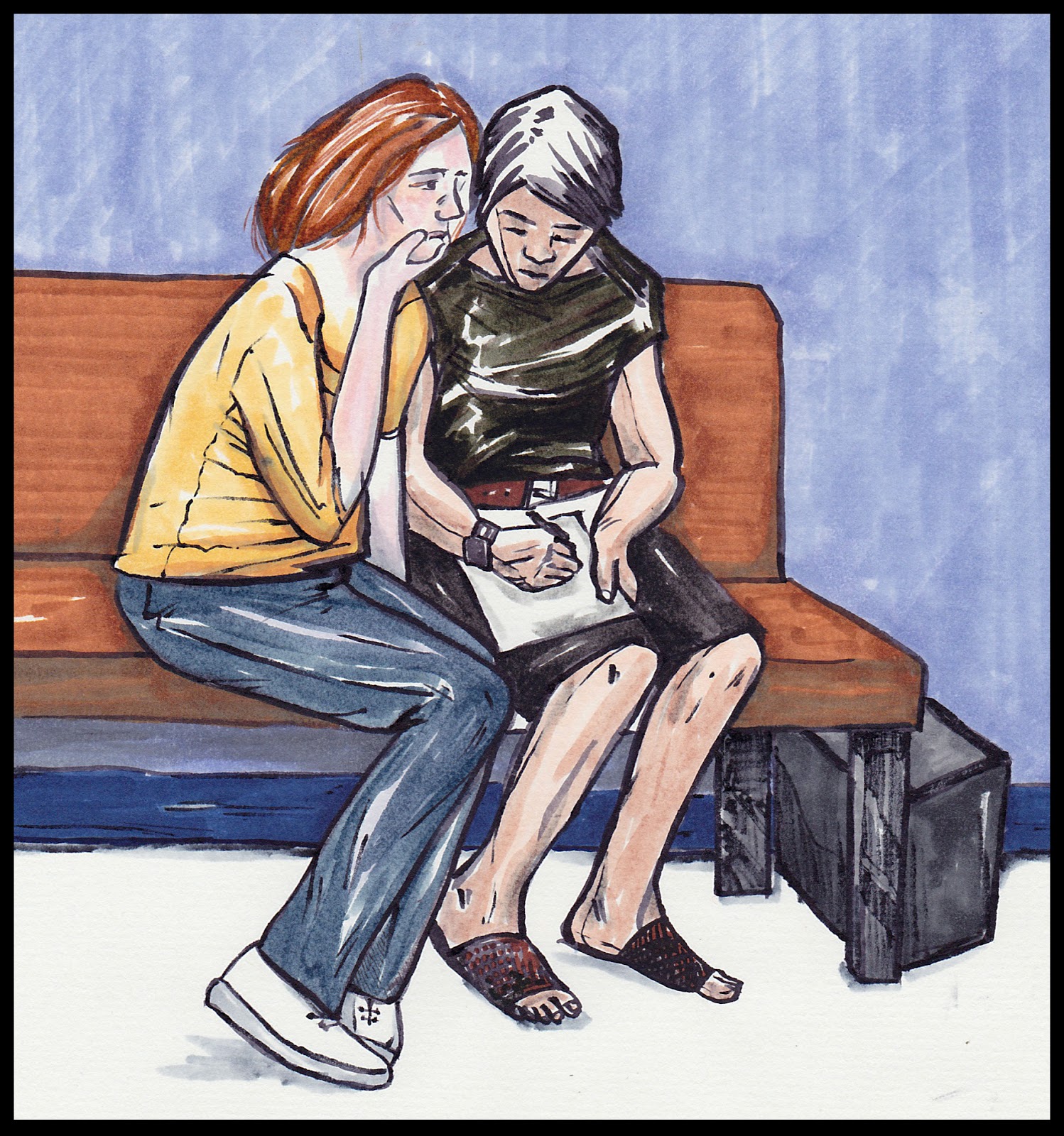
In the waiting room

My first boyfriend and I got back together in university. He developed cancer, was successfully treated after surgery and radiation. It was a very rough time for him. The cancer was testicular, and aggressive, and at the outset we didn't know whether it had metastasised.

Throughout, I was not a comfort to him (our relationship was already crappy) but he got some laughs out of a book of humour for cancer patients, I think by Ben Wicks. Haven't been able to find it since.

A friend and the drummer of a garage band I joined for a little while died of brain cancer. Peach cracked a lot of jokes on the way out. Tumour humour, he called it. He would've loved that Ben Wicks book.

We have a book at home written and illustrated by a husband and wife with a daughter with autism. It's called, Don't Touch the Buttons on the Microwave: An Autism Social Story. Who knows how we got it. I buy things out of bargain bins, bring them home. The book is for insiders. It's comforting, since there's a bit of that in the house, undiagnosed.

It helps to have a picture in mind of where you want something you draw or write to go. I did my best drawing and painting when I was blogging seriously because I figured there were a few people paying attention. It felt like I was talking to someone.


Maybe my little book is for people in infertility clinics or people who have had miscarriages. For the people in their lives who want to know what they are going through. It might end up being too grim to be useful to anybody, but that might be the idea.

This is a panel from a point in the story when the couple is in the waiting room of their clinic. There's a lot of waiting on the TTC (Trying To Conceive).

22 August 2016

A possible collaborator (sounds so Cold War) asked me about working again on a graphic novel project. This galvanised my thoughts around Engineeress, which I'd originally conceived as a short graphic novel about ten years ago. I couldn't find those pages when I looked recently - and it's probably just as well.

Working with the comic format over the last few weeks has been a revelation. The story as I wrote and re-wrote it isn't suitable for a comic. Comics let you communicate a great deal in a few words and images, like poetry. Yet they also have a lot of the same constraints of short stories. How do you get from one scene to the next, or to a new point in time - namely, plot. My little story, as I originally wrote it, was almost a prose poem. I've written in new scenes and plot elements. Because comics is a much more developed medium than what I had had in mind - a shorter short story with a few images - I'm able to explore areas that are pertinent to this story that I thought couldn't be part of it.*

On the risky side, this is a long undertaking, and longer than what I had already had in mind. I would really like to finish a major art project. I haven't done that in many years, I guess since I wrote my book of short stories in 1999.

Everything I need is in front of me. The story, the pictures. But I don't have much knowledge, time or technique. It's hard not to be discouraged. It's also one thing to do the planning and thumbnails with my bits of time sprinkled here and there. But inking and painting happen at a desk.


If you want to follow the development of this story, all related posts are labeled The Engineeress.


17 June 2016

Some pictures that didn't make it


I've been plugging away on my illustrations for The Engineeress, and have finished or planned out all but one (maybe two) of the images. Altogether I hope to have six, and then I think I will send it to some magazines that might like to publish original writing and art together. It is an abnormal format for adult lit, and would be risky for a book publisher, but a magazine might go for it.

I'm feeling a bit sad, though, because I may need to abandon the idea of painting this project, despite having painted two already.

I have found less than two hours to paint since I moved here. I do the vast majority of the childcare, and after the kids are in bed, I still have much to do in the form of finding summer camps, children's activities, etc.

It is very challenging in an environment where you know few people, little of the terminology or customs. My time is rarely my own (- except times like when I eat too much sweet dessert while interviewing a possible new babysitter, and can't sleep from all the sugar!)

Painting is time-consuming, and can't be fitted in around other things like drawing can. And, frankly, after all these years of drawing-because-it's-portable, I'm also better with a marker than a paintbrush anyhow.

Well, whatever. I'll just do it twice if that is what it takes.


I enjoy this project very much. I have learned that in my process, the actual production comes at the end. I don't enjoy re-writing or re-painting, so I prefer to do a lot of preliminary thinking and sketching, and a bit of researching, before settling down to do one kick at the final product. I'm not one for the process espoused by many of my creative writing teachers of the late nineties who thought the story was best started right away, and re-written until it seemed done. Ugh.

The couple at the top are imagining a future baby, and it is a nice enough idea, I guess, but it is couples-oriented. As the story is about a woman and the lonely journey of infertility, it has the wrong concept. These two sketchbook pages also give another idea I had, but I decided in the end not to show the labour in the story, since again the story is about anticipation and disappointment, not the act of giving birth. The flower is a freebie, drawn at the restaurant on the corner of my street, at which I eat several times a month.